دانلود کتاب Mechanics of Materials, 4th Edition

خرید ایبوک Mechanics of Materials سال 2020
برای دانلود ایبوک Mechanics of Materials, 4th Edition و خرید کتاب مقاومت مصالح اثر روی آر کریگ ویرایش چهارم سال 2020 بر روی کلید خرید در انتهای صفحه کلیک کنید. پس از اتصال به درگاه پرداخت هزینه و تکمیل مراحل خرید، لینک دانلود کتاب ایمیل می شود.این ایبوک در فرمت PDF اورجینال و به زبان انگلیسی ارسال می شود.نسخه الکترونیکی کتاب قابلیت کپی برداری copy و Paste دارد.
در صورتی که نیاز به پی دی اف هر کتابی از انتشارات Wiley دارید با گیگاپیپر مکاتبه کنید.
خرید کتاب Mechanics of Materials 4th E-Book – PDF
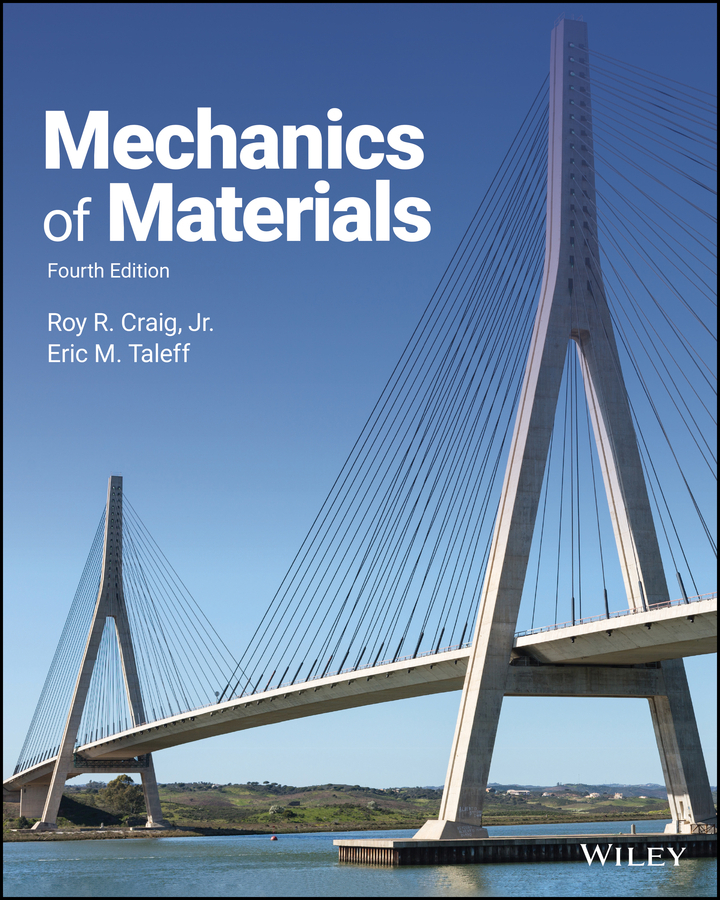
Mechanics of Materials, 4th Edition
Roy R. Craig Jr., Eric M. Taleff
ISBN: 978-1-119-60375-7
Publisher : Wiley
Publication date : August 4, 2020
Edition : 4th
Language : English
Print length : 880 pages
ISBN-10 : 1119612381
ISBN-13 : 978-1119612384
Send email to download :
Price : 35$
https://www.vitalsource.com/products/mechanics-of-materials-enhanced-etext-roy-r-craig-jr-eric-m-v9781119603757

https://www.wiley.com/en-us/shop/general-introductory-mechanical-engineering/mechanics-of-materials-4th-edition-p-9781119603757

https://www.amazon.com/Mechanics-Materials-Roy-Craig-Jr/dp/1119612381
دانلود رایگان کتاب Mechanics of Materials 4th در فرمت پی دی اف اورجینال و اصلی
The fourth edition of Mechanics of Materials is an in-depth yet accessible introduction to the behavior of solid materials under various stresses and strains. Emphasizing the three key concepts of deformable-body mechanics―equilibrium, material behavior, and geometry of deformation―this popular textbook covers the fundamental concepts of the subject while helping students strengthen their problem-solving skills. Throughout the text, students are taught to apply an effective four-step methodology to solve numerous example problems and understand the underlying principles of each application.
Focusing primarily on the behavior of solids under static-loading conditions, the text thoroughly prepares students for subsequent courses in solids and structures involving more complex engineering analyses and Computer-Aided Engineering (CAE). The text provides ample, fully solved practice problems, real-world engineering examples, the equations that correspond to each concept, chapter summaries, procedure lists, illustrations, flow charts, diagrams, and more. This updated edition includes new Python computer code examples, problems, and homework assignments that require only basic programming knowledge.
“This book on dynamics of structures is conceived as a textbook for courses in civil engineering. It includes many topics in the theory of structural dynamics, and applications of this theory to earthquake analysis, response, design, and evaluation of structures. No prior knowledge of structural dynamics is assumed in order to make this book suitable for the reader learning the subject for the first time. The presentation is sufficiently detailed and carefully integrated by cross-referencing to make the book suitable for self-study. This feature of the book, combined with a practically motivated selection of topics, should interest professional engineers, especially those concerned with analysis and design of structures in earthquake country. In developing this book, much emphasis has been placed on making structural dynamics easier to learn by students and professional engineers because many find this subject to be difficult. To achieve this goal, the presentation has been structured around several features: The mathematics is kept as simple as each topic will permit. Analytical procedures are summarized to emphasize the key steps and to facilitate their implementation by the reader. These procedures are illustrated by over 125 worked-out examples, including many comprehensive and realistic examples where the physical interpretation of results is stressed. Some 600 figures have been carefully designed and executed to be pedagogically effective; many of them involve extensive computer simulations of dynamic response of structures. Photographs of structures and structural motions recorded during earthquakes are included to relate the presentation to the real world. The preparation of this book has been inspired by several objectives Relate the structural idealizations studied to the properties of real structures. Present the theory of dynamic response of structures in a manner that emphasizes physical insight into the analytical procedures. Illustrate applications of the theory to solutions of problems motivated by practical applications. Interpret the theoretical results to understand the response of structures to various dynamic excitation’s, with emphasis on earthquake excitation. Apply structural dynamics theory to conduct parametric studies that bring out several fundamental issues in the earthquake response, design, and evaluation of multistory buildings. This mode of presentation should help the reader to achieve a deeper understanding of the subject and to apply with confidence structural dynamicstheory in tackling practical problems, especially in earthquake analysis, design, and evaluation of structures, thus narrowing the gap between theory and practice”–
دانلود ایبوک مقاومت مصالح کریگ ويراست چهارم (زبان اصلی) مولف روی کریگ
ویرایش چهارم کتاب مکانیک مواد، مقدمهای عمیق و در عین حال قابل فهم از رفتار مواد جامد تحت تنشها و کرنشهای مختلف است. این کتاب درسی محبوب با تأکید بر سه مفهوم کلیدی مکانیک اجسام تغییر شکلپذیر – تعادل، رفتار مواد و هندسه تغییر شکل – مفاهیم اساسی موضوع را پوشش میدهد و در عین حال به دانشجویان در تقویت مهارتهای حل مسئله کمک میکند. در سراسر متن، به دانشجویان آموزش داده میشود که یک روش چهار مرحلهای مؤثر را برای حل مسائل نمونه متعدد و درک اصول اساسی هر کاربرد به کار گیرند.
این کتاب با تمرکز اصلی بر رفتار جامدات تحت شرایط بارگذاری استاتیک، دانشجویان را برای دورههای بعدی در جامدات و سازهها که شامل تحلیلهای مهندسی پیچیدهتر و مهندسی به کمک کامپیوتر (CAE) است، کاملاً آماده میکند. این متن، مسائل تمرینی فراوان و کاملاً حلشده، مثالهای مهندسی دنیای واقعی، معادلات مربوط به هر مفهوم، خلاصه فصلها، فهرست رویهها، تصاویر، نمودارهای جریان، نمودارها و موارد دیگر را ارائه میدهد. این ویرایش بهروز شده شامل مثالهای جدید کد کامپیوتری پایتون، مسائل و تکالیفی است که فقط به دانش برنامهنویسی پایه نیاز دارند.
کتاب مکانیک مواد ویرایش چهارم
فهرست مطالب ایبوک مکانیک مواد سال 2020
Table of Contents
1 Introduction to Mechanics of Materials 1
1.1 What Is Mechanics of Materials?, 1
1.2 The Fundamental Equations of Deformable-Body Mechanics, 5
1.3 Problem-Solving Procedures, 7
1.4 Review of Static Equilibrium; Equilibrium of Deformable Bodies, 9
Chapter 1 Review, 19
2 Stress and Strain; Introduction to Design 20
2.1 Introduction, 20
2.2 Normal Stress, 21
2.3 Extensional Strain; Thermal Strain, 29
2.4 Stress-Strain Diagrams; Mechanical Properties of Materials, 35
2.5 Elasticity and Plasticity; Temperature Effects, 43
2.6 Linear Elasticity; Hooke’s Law and Poisson’s Ratio, 46
2.7 Shear Stress and Shear Strain; Shear Modulus, 49
2.8 Introduction to Design—Axial Loads and Direct Shear, 55
2.9 Stresses on an Inclined Plane in an Axially Loaded Member, 62
2.10 Saint-Venant’s Principle, 64
2.11 Hooke’s Law for Plane Stress; the Relationship Between E and G, 66
2.12 General Definitions of Stress and Strain, 69
*2.13 Cartesian Components of Stress; Generalized Hooke’s Law for Isotropic Materials, 79
*2.14 Mechanical Properties of Composite Materials, 84
Chapter 2 Review, 86
3 Axial Deformation 91
3.1 Introduction, 91
3.2 Basic Theory of Axial Deformation, 91
3.3 Examples of Nonuniform Axial Deformation, 99
3.4 Statically Determinate Structures, 109
3.5 Statically Indeterminate Structures, 116
3.6 Thermal Effects on Axial Deformation, 125
3.7 Geometric “Misfits”, 136
3.8 Displacement-Method Solution of Axial-Deformation Problems, 141
*3.9 Force-Method Solution of Axial-Deformation Problems, 153
*3.10 Introduction to the Analysis of Planar Trusses, 162
*3.11 Inelastic Axial Deformation, 170
Chapter 3 Review, 183
4 Torsion 186
4.1 Introduction, 186
4.2 Torsional Deformation of Circular Bars, 187
4.3 Torsion of Linearly Elastic Circular Bars, 190
4.4 Stress Distribution in Circular Torsion Bars; Torsion Testing, 198
4.5 Statically Determinate Assemblages of Uniform Torsion Members, 202
4.6 Statically Indeterminate Assemblages of Uniform Torsion Members, 207
*4.7 Displacement-Method Solution of Torsion Problems, 215
4.8 Power-Transmission Shafts, 221
*4.9 Thin-Wall Torsion Members, 224
*4.10 Torsion of Noncircular Prismatic Bars, 229
*4.11 Inelastic Torsion of Circular Rods, 233
Chapter 4 Review, 239
5 Equilibrium of Beams 241
5.1 Introduction, 241
5.2 Equilibrium of Beams Using Finite Free-Body Diagrams, 246
5.3 Equilibrium Relationships Among Loads, Shear Force, and Bending Moment, 250
5.4 Shear-Force and Bending-Moment Diagrams: Equilibrium Method, 253
5.5 Shear-Force and Bending-Moment Diagrams: Graphical Method, 258
*5.6 Discontinuity Functions to Represent Loads, Shear, and Moment, 265
Chapter 5 Review, 272
6 Stresses in Beams 275
6.1 Introduction, 275
6.2 Strain-Displacement Analysis, 278
6.3 Flexural Stress in Linearly Elastic Beams, 284
6.4 Design of Beams for Strength, 293
6.5 Flexural Stress in Nonhomogeneous Beams, 299
*6.6 Unsymmetric Bending, 306
*6.7 Inelastic Bending of Beams, 316
6.8 Shear Stress and Shear Flow in Beams, 326
6.9 Limitations on the Shear-Stress Formula, 332
6.10 Shear Stress in Thin-Wall Beams, 335
6.11 Shear in Built-up Beams, 345
*6.12 Shear Center, 349
Chapter 6 Review, 356
7 Deflection of Beams 359
7.1 Introduction, 359
7.2 Differential Equations of the Deflection Curve, 360
7.3 Slope and Deflection by Integration—Statically Determinate Beams, 366
7.4 Slope and Deflection by Integration—Statically Indeterminate Beams, 379
*7.5 Use of Discontinuity Functions to Determine Beam Deflections, 384
7.6 Slope and Deflection of Beams: Superposition Method, 391
*7.7 Slope and Deflection of Beams: Displacement Method, 409
Chapter 7 Review, 416
8 Transformation of Stress And Strain; Mohr’s Circle 418
8.1 Introduction, 418
8.2 Plane Stress, 419
8.3 Stress Transformation for Plane Stress, 421
8.4 Principal Stresses and Maximum Shear Stress, 428
8.5 Mohr’s Circle for Plane Stress, 434
8.6 Triaxial Stress; Absolute Maximum Shear Stress, 441
8.7 Plane Strain, 448
8.8 Transformation of Strains in a Plane, 449
8.9 Mohr’s Circle for Strain, 453
8.10 Measurement of Strain; Strain Rosettes, 459
*8.11 Analysis of Three-Dimensional Strain, 464
Chapter 8 Review, 466
9 Pressure Vessels; Stresses Due to Combined Loading 469
9.1 Introduction, 469
9.2 Thin-Wall Pressure Vessels, 470
9.3 Stress Distribution in Beams, 476
9.4 Stresses Due to Combined Loads, 481
Chapter 9 Review, 490
10 Buckling Of Columns 492
10.1 Introduction, 492
10.2 The Ideal Pin-Ended Column; Euler Buckling Load, 495
10.3 The Effect of End Conditions on Column Buckling, 501
*10.4 Eccentric Loading; the Secant Formula, 508
*10.5 Imperfections in Columns, 514
*10.6 Inelastic Buckling of Ideal Columns, 515
10.7 Design of Centrally Loaded Columns, 519
Chapter 10 Review, 526
11 Energy Methods 528
11.1 Introduction, 528
11.2 Work and Strain Energy, 529
11.3 Elastic Strain Energy for Various Types of Loading, 536
11.4 Work-Energy Principle for Calculating Deflections, 542
11.5 Castigliano’s Second Theorem; the Unit-Load Method, 547
*11.6 Virtual Work, 558
*11.7 Strain-Energy Methods, 562
*11.8 Complementary-Energy Methods, 567
*11.9 Dynamic Loading; Impact, 577
Chapter 11 Review, 582
12 Special Topics Related to Design 584
12.1 Introduction, 584
12.2 Stress Concentrations, 584
*12.3 Failure Theories, 591
*12.4 Fatigue and Fracture, 599
Chapter 12 Review, 604
PROBLEMS P-1
A Numerical Accuracy; Approximations A-1
A.1 Numerical Accuracy; Significant Digits, A-1
A.2 Approximations, A-2
B Systems of Units A-3
B.1 Introduction, A-3
B.2 SI Units, A-3
B.3 U.S. Customary Units; Conversion of Units, A-5
B.4 Useful Physical Properties, A-6
C Geometric Properties of Plane Areas A-7
C.1 First Moments of Area; Centroid, A-7
C.2 Moments of Inertia of an Area, A-10
C.3 Product of Inertia of an Area, A-14
C.4 Area Moments of Inertia about Inclined Axes; Principal Moments of Inertia, A-16
C.5 Geometric Properties of Plane Areas, A-22
D Section Properties of Selected Structural Shapes A-24
E Deflections and Slopes of Beams; Fixed-End Actions A-35
F Mechanical Properties of Selected Engineering Materials A-40
Answers to Selected Odd-Numbered Problems Ans-1
References R-1
Index I-1
About the Author
Roy R. Craig, Jr., is the John J. McKetta Energy Professor Emeritus in Engineering in the Department of Aerospace Engineering and Engineering Mechanics at the University of Texas at Austin. He received his BS degree in Civil Engineering from the University of Oklahoma and his MS and PhD degrees in Theoretical and Applied Mechanics from the University of Illinois at Urbana-Champaign. From 1961 until 2001 he was on the faculty of the University of Texas at Austin. Dr. Craig received numerous teaching awards and faculty leadership awards, and he is the author of one other textbook, Fundamentals of Structural Dynamics.
Eric M. Taleff is the Charlotte Maer Patton Centennial Fellow in Engineering in the Department of Mechanical Engineering at the University of Texas at Austin. He received his BS degrees in Mechanical Engineering and in Materials Science from Rice University, an MS degree in Materials Science and Engineering from Stanford University, and a PhD in Mechanical Engineering from Stanford University. He has been on the faculty at the University of Texas at Austin since 1995. He is a fellow of ASM International and a Brimacombe Medalist of The Minerals, Metals & Materials Society. He received the Champion H. Mathewson Medal Award from the American Institute of Mining, Metallurgical, and Petroleum Engineers and the Minerals, Metals & Materials Society. He holds a Most Valuable Colleague Award, associated with the John M. Campbell Award, from General Motors.