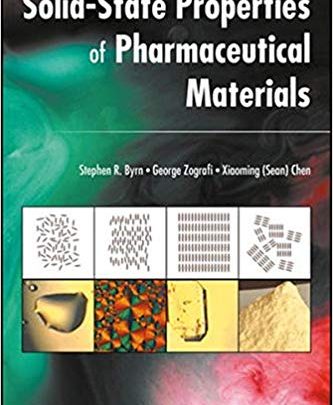
Presents a detailed discussion of important solid-state properties, methods, and applications of solid-state analysis
Illustrates the various phases or forms that solids can assume and discussesvarious issues related to the relative stability of solid forms and tendencies to undergo transformation
Covers key methods of solid state analysis including X-ray powder diffraction, thermal analysis, microscopy, spectroscopy, and solid state NMR
Reviews critical physical attributes of pharmaceutical materials, mainly related to drug substances, including particle size/surface area, hygroscopicity, mechanical properties, solubility, and physical and chemical stability
Showcases the application of solid state material science in rational selection of drug solid forms, analysis of various solid forms within drug substance and the drug product, and pharmaceutical product development
Introduces appropriate manufacturing and control procedures using Quality by Design, and other strategies that lead to safe and effective products with a minimum of resources and time
This second, completely revised edition contains a wealth of information on the properties and use of titanium dioxide pigments. It gives the reader a comprehensive insight into how titanium dioxide works and its possible applications, as well as discussing the current state of development and its use in various forms for UV absorbers, effect pigments and catalytic materials. Practitioners will especially welcome the fact that Chapter 4 now includes information on the scope for, and limitations on, replacing titanium dioxide pigments in formulations.
General Chemistry for Engineers is tailored for a one-semester freshman-level college course for students pursuing engineering degrees. The book offers a balance of conciseness, rigor, and depth needed to prepare students for more advanced coursework and careers in various engineering specialties, such as civil, environmental, electrical, computer, mechanical and industrial engineering, in addition to chemical engineering.
This text leads students through the breadth of a typical two-semester sequence in general chemistry. It elucidates the key concepts and skills important for entering engineering students, including problem solving, qualitative and quantitative thinking, and importance of units. Examples are drawn from problems of interest to modern engineers, including alternative energy, advanced materials, and the environment. The book is the result of the author’s unique experiences teaching approximately 2,500 freshman in chemistry and upper-level students in chemical and biological engineering, in addition to leading research and development teaching in the medical device and specialty pharmaceutical industries. The author received a variety of teaching awards at Northeastern honoring his work in making an intense, fast-pace course manageable and exciting.
Paul A. DiMilla is an Associate Academic Specialist in Chemistry & Chemical Biology and Chemical Engineering at Northeastern University. He received his B.S. from the Massachusetts Institute of Technology and his Ph.D. from the University of Pennsylvania, both in Chemical Engineering. He was a Postdoctoral Fellow in Chemistry at Harvard University prior to beginning his faculty career in Chemical and Biomedical Engineering at Carnegie Mellon University, where he co-founded Automated Cell, Inc.
Paul was a Visiting Professor of Bioengineering at the Franklin W. Olin College of Engineering and a Visiting Scholar in Biomedical Engineering at Boston University. Additionally, he led R&D teams in the private sector, developing tissue-engineered medical products and drug- generating biodegradable polymers. He received an Early Career Development Award from the NSF, a Searle Scholar Award, and the first Whitaker Young Investigator Award. He is also the inventor on seven issued US patents
A modern, accessible, and applied approach to chemical thermodynamics
Thermodynamics is central to the practice of chemical engineering, yet students sometimes feel that the discipline is too abstract while they are studying the subject.
By providing an applied and modern approach, Stanley Sandler’s Chemical, Biochemical, and Engineering Thermodynamics, Fourth Edition helps students see the value and relevance of studying thermodynamics to all areas of chemical engineering, and gives them the depth of coverage they need to develop a solid understanding of the key principles in the field.
Key Features
* Highlights applications of thermodynamics to subjects that chemical engineering students will see in later courses.
* Realistic problems introduce students to the types of challenges they will encounter in industry and graduate research.
* The Fourth Edition has been reorganized into 15 chapters, providing shorter chapters that introduce students to the subject in more bite-sized pieces.
* Presents biochemical examples, particularly in Chapters 11 and 12, and in all of Chapter 15 entitled “Biochemical Applications of Thermodynamics.”
* Coverage of environmental and safety applications of thermodynamics provides course material useful for ABET accreditation.
* Includes a brief introduction to the new field of product engineering in Chapter 12.
* Instructional objectives and nomenclature lists at the beginning of each chapter provide useful study tools.
* Students can solve problems using MATHCAD(r), MATLAB(r) and Visual Basic programs that accompany this textbook.
* An accompanying CD features a 120-day trial version of MATHCAD, as well as MATHCAD worksheets, an extensive properties database, and Windows-friendly Visual Basic and MATLAB programs for equation of state and UNIFAC calculations. (These worksheets and programs are also available online at the book website.)
* Also included on the CD are PDF files of important data figures that students can download and print for use in solving homework problems.
www.wiley.com/college/sandler
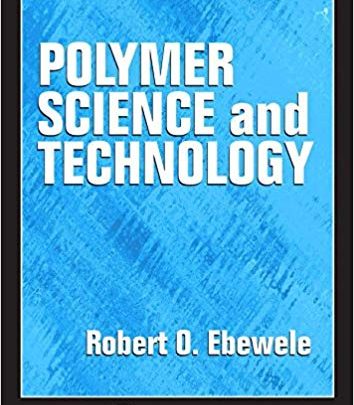
Your search for the perfect polymers textbook ends here – with Polymer Science and Technology. By incorporating an innovative approach and consolidating in one volume the fundamentals currently covered piecemeal in several books, this efficient text simplifies the learning of polymer science.
The book is divided into three main sections: polymer fundamentals; polymer formation and conversion into useful articles; and polymer properties and applications. Polymer Science and Technology emphasizes the basic, qualitative understanding of the concepts rather than rote memorization or detailed mathematical analysis. Since the book focuses on the ultimate property of the finished product, it minimizes laborious descriptions of experimental procedures used for the characterization of polymers. Instead, the author highlights how the various stages involved in the production of the finished product influence its properties. Well-organized, clear-cut, and user-friendly, Polymer Science and Technology is an outstanding textbook for teaching junior and senior level undergraduates and first year graduate students in an introductory course covering the challenging subject of polymers.
دانلود کتاب Chemistry for Enhancing the Production of Oil and Gas
برای خرید کتاب Chemistry for Enhancing the Production of Oil and Gas باگیگاپیپر مکاتبه کنید
خرید کتاب Chemistry for Enhancing the Production of Oil and Gas
Chemistry for Enhancing the Production of Oil and Gas Paperback – 2014
by Wayne Frenier & Murtaza Ziauddin (Author)
Paperback: 616 pages
Publisher: Society of Petroleum Engineers (2014)
ISBN-10: 161399317X
ISBN-13: 978-1613993170
Price: 20$
Chemistry for Enhancing the Production of Oil and Gas provides an overview of the science and technology of the use of production chemicals to enhance and maintain oil and gas production. This new book emphasizes the technical aspects of the production management from the perspective of the upstream oil and gas industry. The chapters describe the production environment, problems that require chemical intervention, and thus, the need for the thousands of difference chemicals that are in use. They will review the important chemical and physical principles that are common to most, if not all, of the enhancement treatments. They also discuss aspects of the use and mechanisms of the complex chemistries that take place with the application of flow assurance chemicals, during stimulation (reactive chemistry and prop fracturing) and chemically improved oil recovery, including the use of chemical tracers. A final chapter emphasizes the importance of health, safety, and environmental compliance in all aspects of oilfield treatments. Most of the chapters of the book end with a section where successful chemical enhancement or control methods have been used to solve specific production problems.
دانلود کتاب Analysis, Synthesis, and Design of Chemical Processes (5th Edition) (Prentice Hall International Series in the Physical and Chemical Engineering Sciences) 5th Edition
برای خرید کتاب Analysis, Synthesis, and Design of Chemical Processes (5th Edition) (Prentice Hall International Series in the Physical and Chemical Engineering Sciences) 5th Edition و دانلود ایبوک تجزیه و تحلیل، سنتز و طراحی مواد شیمیایی با گیگاپیپر مکاتبه کنید
خرید کتاب Analysis, Synthesis, and Design of Chemical Processes (5th Edition) (Prentice Hall International Series in the Physical and Chemical Engineering Sciences) 5th Edition
دانلود کتاب تجزیه و تحلیل، سنتز و طراحی مواد شیمیایی نسخه پنجم Download PDF Analysis, Synthesis, and Design of Chemical Processes 5th Edition
Analysis, Synthesis, and Design of Chemical Processes (5th Edition) (Prentice Hall International Series in the Physical and Chemical Engineering Sciences) 5th Edition
by Richard Turton (Author), Joseph A. Shaeiwitz (Author), Debangsu Bhattacharyya (Author), Wallace B. Whiting (Author)
Series: Prentice Hall International Series in the Physical and Chemical Engineering Sciences
دانلود کتاب تجزیه و تحلیل، سنتز و طراحی مواد شیمیایی نسخه پنجم
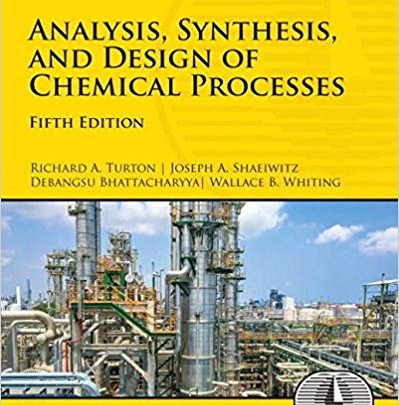
The Leading Integrated Chemical Process Design Guide: With Extensive Coverage of Equipment Design and Other Key Topics
More than ever, effective design is the focal point of sound chemical engineering. Analysis, Synthesis, and Design of Chemical Processes, Fifth Edition, presents design as a creative process that integrates the big-picture and small details, and knows which to stress when and why. Realistic from start to finish, it moves readers beyond classroom exercises into open-ended, real-world problem solving. The authors introduce up-to-date, integrated techniques ranging from finance to operations, and new plant design to existing process optimization.
The fifth edition includes updated safety and ethics resources and economic factors indices, as well as an extensive, new section focused on process equipment design and performance, covering equipment design for common unit operations, such as fluid flow, heat transfer, separations, reactors, and more.
Download PDF Analysis, Synthesis, and Design of Chemical Processes 5th Edition
Conceptualization and analysis: process diagrams, configurations, batch processing, product design, and analyzing existing processes
Economic analysis: estimating fixed capital investment and manufacturing costs, measuring process profitability, and more
Synthesis and optimization: process simulation, thermodynamic models, separation operations, heat integration, steady-state and dynamic process simulators, and process regulation
Chemical equipment design and performance: a full section of expanded and revamped coverage of designing process equipment and evaluating the performance of current equipment
Advanced steady-state simulation: goals, models, solution strategies, and sensitivity and optimization results
Dynamic simulation: goals, development, solution methods, algorithms, and solvers
Societal impacts: ethics, professionalism, health, safety, environmental issues, and green engineering
Interpersonal and communication skills: working in teams, communicating effectively, and writing better reports
This text draws on a combined 55 years of innovative instruction at West Virginia University (WVU) and the University of Nevada, Reno. It includes suggested curricula for one- and two-semester design courses, case studies, projects, equipment cost data, and extensive preliminary design information for jump-starting more detailed analyses