برچسب: کتاب ریاضی

  • دانلود کتاب Free and Moving Boundary Problems

    دانلود کتاب Free and Moving Boundary Problems

    دانلود کتابFree and Moving Boundary Problems (Oxford Science Publications)

    جهت دانلود کتاب Free and Moving Boundary Problems (Oxford Science Publications) با ما مکاتبه کنبد.  کتاب مشکلات مرزی آزاد و حرکتی پس از واریز هزینه ارسال میشود. ایبوک 9780198533702در آرشیو گیگاپیپر موجود است.

    خرید کتاب Free and Moving Boundary Problems

    دانلود کتاب Free and Moving Boundary Problems (Oxford Science Publications) کتاب مشکلات مرزی آزاد و حرکتی ایبوک 9780198533702
    دانلود کتاب Free and Moving Boundary Problems (Oxford Science Publications) کتاب مشکلات مرزی آزاد و حرکتی ایبوک 9780198533702

    Free and Moving Boundary Problems (Oxford Science Publications)
    by John Crank (Author)

    Series: Oxford Science Publications

    Paperback: 424 pages
    Publisher: Clarendon Press (February 26, 1987)
    Language: English
    ISBN-10: 9780198533702
    ISBN-13: 978-0198533702
    ASIN: 0198533705

    Price: 10$

    Free Download Some Pages Before Pay

    درباره ایبوک Free and Moving Boundary Problems

    Here is a wide-ranging, comprehensive account of the mathematical formulation of problems involving free boundaries as they occur in such diverse areas as hydrology, metallurgy, chemical engineering, soil science, molecular biology, materials science, and steel and glass production. Many new methods of solution are discussed, including modern computer techniques which address multidimensional, multiphase practical problems.

    درباره نویسنده ایبوک Free and Moving Boundary Problems

    John Crank is at Brunel University.

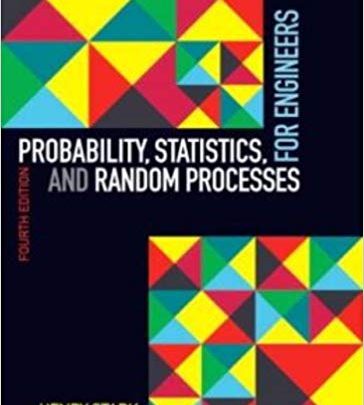
  • دانلود کتاب Probability, Statistics, and Random Processes for Engineers 4th Edition

    دانلود کتاب Probability, Statistics, and Random Processes for Engineers 4th Edition

    دانلود PDF کتاب Probability, Statistics, and Random Processes for Engineers

    برای دانلود کتاب Probability, Statistics, and Random Processes for Engineers نسخه چهارم با ما مکاتبه کنید. این کتاب در آرشیو گیگاپیپر موجود است و پس از واریز هزینه PDF کتاب ارسال می شود.

     گیگاپیپر

    Probability, Statistics, and Random Processes for Engineers 4th Edition, Kindle Edition
    by Henry Stark (Author), John Woods (Author)

    Paperback: 704 pages
    Publisher: Pearson; 4 edition (August 20, 2011)
    Language: English

    Price : 40$
    ISBN-10: 0132311232
    ISBN-13: 978-0132311236

    فروش کیندل کتاب امازون

    در صورتی که هر کتابی از امازون نیاز دارید، کافیست به بخش Buy a Kindle و یا ادرس https://www.amazon.com/gp/product/B00ZV9PXP2/?ie=UTF8&ref_=topnav_storetab_kstore بروید. در این بخش عنوان کتاب مورد نظر را وارد کنید. در صورتی که دارای نسخه Kindle باشد، با کمتر از 90 درصد قیمت اصلی برایتان تهیه می کنیم.

    دانلود ایبوک Probability, Statistics, and Random Processes for Engineers 4th Edition

    For courses in Probability and Random Processes.

    Probability, Statistics, and Random Processes for Engineers, 4e is a useful text for electrical and computer engineers. This book is a comprehensive treatment of probability and random processes that, more than any other available source, combines rigor with accessibility. Beginning with the fundamentals of probability theory and requiring only college-level calculus, the book develops all the tools needed to understand more advanced topics such as random sequences, continuous-time random processes, and statistical signal processing.

    Download PDF Probability, Statistics, and Random Processes for Engineers 4th Edition

    The book progresses at a leisurely pace, never assuming more knowledge than contained in the material already covered. Rigor is established by developing all results from the basic axioms and carefully defining and discussing such advanced notions as stochastic convergence, stochastic integrals and resolution of stochastic processes.

    دانلود کتاب Probability, Statistics, and Random Processes for Engineers 4th Edition

    File Size: 23871 KB
    Print Length: 704 pages
    Simultaneous Device Usage: Up to 2 simultaneous devices, per publisher limits
    Publisher: Pearson; 4 edition (September 12, 2011)
    Publication Date: September 12, 2011
    Language: English
    ASIN: B0093K4RZ2

    فهرست مطالب کیندل Probability, Statistics, and Random Processes for Engineers 4th Edition

    در ادامه فهرست مطالب ایبوک احتمال، آمار و فرآیندهای تصادفی برای مهندسین آورده شده است.

    Table of Contents
    Preface
    1 Introduction to Probability 1
    1.1 Introduction: Why Study Probability? 1
    1.2 The Different Kinds of Probability 2
    Probability as Intuition 2
    Probability as the Ratio of Favorable to Total Outcomes (Classical Theory) 3
    Probability as a Measure of Frequency of Occurrence 4
    Probability Based on an Axiomatic Theory 5
    1.3 Misuses, Miscalculations, and Paradoxes in Probability 7
    1.4 Sets, Fields, and Events 8
    Examples of Sample Spaces 8
    1.5 Axiomatic Definition of Probability 15
    1.6 Joint, Conditional, and Total Probabilities; Independence 20
    Compound Experiments 23
    1.7 Bayes’ Theorem and Applications 35
    1.8 Combinatorics 38

    فروش کیندل کتاب امازون Probability, Statistics, and Random Processes for Engineers 4th Edition

    Occupancy Problems 42
    Extensions and Applications 46
    1.9 Bernoulli Trials-Binomial and Multinomial Probability Laws 48
    Multinomial Probability Law 54
    1.10 Asymptotic Behavior of the Binomial Law: The Poisson Law 57
    1.11 Normal Approximation to the Binomial Law 63
    Summary 65
    Problems 66
    References 77

    فروش کیندل کتاب امازون Probability, Statistics, and Random Processes for Engineers

    2 Random Variables 79
    2.1 Introduction 79
    2.2 Definition of a Random Variable 80
    2.3 Cumulative Distribution Function 83
    Properties of FX(x) 84
    Computation of FX(x) 85
    2.4 Probability Density Function (pdf) 88
    Four Other Common Density Functions 95
    More Advanced Density Functions 97
    2.5 Continuous, Discrete, and Mixed Random Variables 100
    Some Common Discrete Random Variables 102
    2.6 Conditional and Joint Distributions and Densities 107
    Properties of Joint CDF FXY (x, y) 118
    2.7 Failure Rates 137
    Summary 141
    Problems 141
    References 149
    Additional Reading 149

    فروش کیندل امازون Probability, Statistics, and Random Processes for Engineers 4th Edition

    3 Functions of Random Variables 151
    3.1 Introduction 151
    Functions of a Random Variable (FRV): Several Views 154
    3.2 Solving Problems of the Type Y = g(X) 155
    General Formula of Determining the pdf of Y = g(X) 166
    3.3 Solving Problems of the Type Z = g(X, Y ) 171
    3.4 Solving Problems of the Type V = g(X, Y ), W = h(X, Y ) 193
    Fundamental Problem 193
    Obtaining fVW Directly from fXY 196
    3.5 Additional Examples 200
    Summary 205
    Problems 206
    References 214
    Additional Reading 214

    فروش امازون کیندل Probability, Statistics, and Random Processes for Engineers 4th Edition

    4 Expectation and Moments 215
    4.1 Expected Value of a Random Variable 215
    On the Validity of Equation 4.1-8 218
    4.2 Conditional Expectations 232
    Conditional Expectation as a Random Variable 239
    4.3 Moments of Random Variables 242
    Joint Moments 246
    Properties of Uncorrelated Random Variables 248
    Jointly Gaussian Random Variables 251
    4.4 Chebyshev and Schwarz Inequalities 255
    Markov Inequality 257
    The Schwarz Inequality 258
    4.5 Moment-Generating Functions 261
    4.6 Chernoff Bound 264
    4.7 Characteristic Functions 266
    Joint Characteristic Functions 273
    The Central Limit Theorem 276
    4.8 Additional Examples 281
    Summary 283
    Problems 284
    References 293
    Additional Reading 294

    دانلود کیندل آمازون Probability, Statistics, and Random Processes for Engineers

    5 Random Vectors 295
    5.1 Joint Distribution and Densities 295
    5.2 Multiple Transformation of Random Variables 299
    5.3 Ordered Random Variables 302
    Distribution of area random variables 305
    5.4 Expectation Vectors and Covariance Matrices 311
    5.5 Properties of Covariance Matrices 314
    Whitening Transformation 318
    5.6 The Multidimensional Gaussian (Normal) Law 319
    5.7 Characteristic Functions of Random Vectors 328
    Properties of CF of Random Vectors 330
    The Characteristic Function of the Gaussian (Normal) Law 331
    Summary 332
    Problems 333
    References 339
    Additional Reading 339

    خرید کیندل کتاب Probability, Statistics, and Random Processes for Engineers 4th

    6 Statistics: Part 1 Parameter Estimation 340
    6.1 Introduction 340
    Independent, Identically Distributed (i.i.d.) Observations 341
    Estimation of Probabilities 343
    6.2 Estimators 346
    6.3 Estimation of the Mean 348
    Properties of the Mean-Estimator Function (MEF) 349
    Procedure for Getting a d-confidence Interval on the Mean of a Normal
    Random Variable When sX Is Known 352
    Confidence Interval for the Mean of a Normal Distribution When sX Is Not
    Known 352
    Procedure for Getting a d-Confidence Interval Based on n Observations on
    the Mean of a Normal Random Variable when sX Is Not Known 355
    Interpretation of the Confidence Interval 355
    6.4 Estimation of the Variance and Covariance 355
    Confidence Interval for the Variance of a Normal Random
    variable 357
    Estimating the Standard Deviation Directly 359
    Estimating the covariance 360
    6.5 Simultaneous Estimation of Mean and Variance 361
    6.6 Estimation of Non-Gaussian Parameters from Large Samples 363
    6.7 Maximum Likelihood Estimators 365
    6.8 Ordering, more on Percentiles, Parametric Versus Nonparametric Statistics 369
    The Median of a Population Versus Its Mean 371
    Parametric versus Nonparametric Statistics 372
    Confidence Interval on the Percentile 373
    Confidence Interval for the Median When n Is Large 375
    6.9 Estimation of Vector Means and Covariance Matrices 376
    Estimation of µ 377
    Estimation of the covariance K 378
    6.10 Linear Estimation of Vector Parameters 380
    Summary 384
    Problems 384
    References 388
    Additional Reading 389

    خرید کیندل Probability Statistics and Random Processes for Engineers 4th Edition

    7 Statistics: Part 2 Hypothesis Testing 390
    7.1 Bayesian Decision Theory 391
    7.2 Likelihood Ratio Test 396
    7.3 Composite Hypotheses 402
    Generalized Likelihood Ratio Test (GLRT) 403
    How Do We Test for the Equality of Means of Two Populations? 408
    Testing for the Equality of Variances for Normal Populations:
    The F-test 412
    Testing Whether the Variance of a Normal Population Has a
    Predetermined Value: 416
    7.4 Goodness of Fit 417
    7.5 Ordering, Percentiles, and Rank 423
    How Ordering is Useful in Estimating Percentiles and the Median 425
    Confidence Interval for the Median When n Is Large 428
    Distribution-free Hypothesis Testing: Testing If Two Population are the
    Same Using Runs 429
    Ranking Test for Sameness of Two Populations 432
    Summary 433
    Problems 433
    References 439

    خرید kindle آمازون Probability, Statistics, and Random Processes for Engineers

    8 Random Sequences 441
    8.1 Basic Concepts 442
    Infinite-length Bernoulli Trials 447
    Continuity of Probability Measure 452
    Statistical Specification of a Random Sequence 454
    8.2 Basic Principles of Discrete-Time Linear Systems 471
    8.3 Random Sequences and Linear Systems 477
    8.4 WSS Random Sequences 486
    Power Spectral Density 489
    Interpretation of the psd 490
    Synthesis of Random Sequences and Discrete-Time Simulation 493
    Decimation 496
    Interpolation 497
    8.5 Markov Random Sequences 500
    ARMA Models 503
    Markov Chains 504
    8.6 Vector Random Sequences and State Equations 511
    8.7 Convergence of Random Sequences 513
    8.8 Laws of Large Numbers 521
    Summary 526
    Problems 526
    References 541

    خرید کیندل Probability, Statistics, and Random Processes for Engineers

    9 Random Processes 543
    9.1 Basic Definitions 544
    9.2 Some Important Random Processes 548
    Asynchronous Binary Signaling 548
    Poisson Counting Process 550
    Alternative Derivation of Poisson Process 555
    Random Telegraph Signal 557
    Digital Modulation Using Phase-Shift Keying 558
    Wiener Process or Brownian Motion 560
    Markov Random Processes 563
    Birth-Death Markov Chains 567
    Chapman-Kolmogorov Equations 571
    Random Process Generated from Random Sequences 572
    9.3 Continuous-Time Linear Systems with Random Inputs 572
    White Noise 577
    9.4 Some Useful Classifications of Random Processes 578
    Stationarity 579
    9.5 Wide-Sense Stationary Processes and LSI Systems 581
    Wide-Sense Stationary Case 582
    Power Spectral Density 584
    An Interpretation of the psd 586
    More on White Noise 590
    Stationary Processes and Differential Equations 596
    9.6 Periodic and Cyclostationary Processes 600
    9.7 Vector Processes and State Equations 606
    State Equations 608
    Summary 611
    Problems 611
    References 633

    خرید kindle کتاب Probability, Statistics, and Random Processes for Engineers

    Chapters 10 and 11 are available as Web chapters on the companion
    Web site at http://www.pearsonhighered.com/stark.
    10 Advanced Topics in Random Processes 635
    10.1 Mean-Square (m.s.) Calculus 635
    Stochastic Continuity and Derivatives [10-1] 635
    Further Results on m.s. Convergence [10-1] 645
    10.2 Mean-Square Stochastic Integrals 650
    10.3 Mean-Square Stochastic Differential Equations 653
    10.4 Ergodicity [10-3] 658
    10.5 Karhunen-Lo`eve Expansion [10-5] 665
    10.6 Representation of Bandlimited and Periodic Processes 671
    Bandlimited Processes 671
    Bandpass Random Processes 674
    WSS Periodic Processes 677
    Fourier Series for WSS Processes 680
    Summary 682
    Appendix: Integral Equations 682
    Existence Theorem 683
    Problems 686
    References 699

    خرید Probability, Statistics, and Random Processes for Engineers kindle

    11 Applications to Statistical Signal Processing 700
    11.1 Estimation of Random Variables and Vectors 700
    More on the Conditional Mean 706
    Orthogonality and Linear Estimation 708
    Some Properties of the Operator ˆE 716
    11.2 Innovation Sequences and Kalman Filtering 718
    Predicting Gaussian Random Sequences 722
    Kalman Predictor and Filter 724
    Error-Covariance Equations 729
    11.3 Wiener Filters for Random Sequences 733
    Unrealizable Case (Smoothing) 734
    Causal Wiener Filter 736
    11.4 Expectation-Maximization Algorithm 738
    Log-likelihood for the Linear Transformation 740
    Summary of the E-M algorithm 742
    E-M Algorithm for Exponential Probability
    Functions 743
    Application to Emission Tomography 744
    Log-likelihood Function of Complete Data 746
    E-step 747
    M-step 748
    11.5 Hidden Markov Models (HMM) 749
    Specification of an HMM 751
    Application to Speech Processing 753
    Efficient Computation of P[E|M] with a Recursive
    Algorithm 754
    Viterbi Algorithm and the Most Likely State Sequence
    for the Observations 756
    11.6 Spectral Estimation 759
    The Periodogram 760
    Bartlett’s Procedure—Averaging Periodograms 762
    Parametric Spectral Estimate 767
    Maximum Entropy Spectral Density 769
    11.7 Simulated Annealing 772
    Gibbs Sampler 773
    Noncausal Gauss-Markov Models 774
    Compound Markov Models 778
    Gibbs Line Sequence 779
    Summary 783
    Problems 783
    References 788

    فروش کیندل Probability, Statistics, and Random Processes for Engineers 4th Edition

    Appendix A Review of Relevant Mathematics A-1
    A.1 Basic Mathematics A-1
    Sequences A-1
    Convergence A-2
    Summations A-3
    Z-Transform A-3
    A.2 Continuous Mathematics A-4
    Definite and Indefinite Integrals A-5
    Differentiation of Integrals A-6
    Integration by Parts A-7
    Completing the Square A-7
    Double Integration A-8
    Functions A-8
    A.3 Residue Method for Inverse Fourier Transformation A-10
    Fact A-11
    Inverse Fourier Transform for psd of Random Sequence A-13
    A.4 Mathematical Induction A-17
    References A-17
    Appendix B Gamma and Delta Functions B-1
    B.1 Gamma Function B-1
    B.2 Incomplete Gamma Function B-2
    B.3 Dirac Delta Function B-2
    References B-5

    فروش کیندل Probability, Statistics, and Random Processes for Engineers 4th

    Appendix C Functional Transformations and Jacobians C-1
    C.1 Introduction C-1
    C.2 Jacobians for n = 2 C-2
    C.3 Jacobian for General n C-4

    خرید کیندل آمازون Probability, Statistics, and Random Processes for Engineers 4th Edition

    Appendix D Measure and Probability D-1
    D.1 Introduction and Basic Ideas D-1
    Measurable Mappings and Functions D-3
    D.2 Application of Measure Theory to Probability D-3
    Distribution Measure D-4

    دانلود کتاب احتمال، آمار و فرآیندهای تصادفی برای مهندسین نسخه چهارم

    Appendix E Sampled Analog Waveforms and Discrete-time Signals E-1
    Appendix F Independence of Sample Mean and Variance for Normal
    Random Variables F-1
    Appendix G Tables of Cumulative Distribution Functions: the Normal,
    Student t, Chi-square, and F G-1
    Index I-1

    دانلود رایگان کتاب Probability, Statistics, and Random Processes for Engineers

    برای اینکه از کیفیت PDF اورجینال کتاب Probability Statistics and Random Processes for Engineers اطمینان پیدا کنید، دو صفحه از کتاب به صورت رایگان آورده شده است.

    دانلود رایگان کتاب Probability, Statistics, and Random Processes for Engineers 4th Edition فروش کیندل کتاب امازون دانلود PDF کتاب حتمال، آمار و فرآیندهای تصادفی
    دانلود رایگان کتاب Probability, Statistics, and Random Processes for Engineers 4th Edition فروش کیندل کتاب امازون دانلود PDF کتاب حتمال، آمار و فرآیندهای تصادفی
     Free Download PDF Probability, Statistics, and Random Processes for Engineers 4th Edition فروش کیندل کتاب امازون دانلود PDF کتاب احتمال، آمار و فرآیندهای تصادفی
    Free Download PDF Probability, Statistics, and Random Processes for Engineers 4th Edition فروش کیندل کتاب امازون دانلود PDF کتاب احتمال، آمار و فرآیندهای تصادفی
     Free Kindle Probability, Statistics, and Random Processes for Engineers 4th Edition فروش کیندل کتاب امازون دانلود PDF کتاب احتمال، آمار و فرآیندهای تصادفی
    Free Kindle Probability, Statistics, and Random Processes for Engineers 4th Edition فروش کیندل کتاب امازون دانلود PDF کتاب احتمال، آمار و فرآیندهای تصادفی
  • دانلود ایبوک Precalculus: Mathematics for Calculus 7th

    دانلود ایبوک Precalculus: Mathematics for Calculus 7th

    دانلود کتاب Precalculus: Mathematics for Calculus

    نسخه 7 ام کتاب Precalculus: Mathematics for Calculus سال 2015 در ارشیو گیگاپیپر موجود است. نویسندگان کتاب استوارت و Redlin می باشد. نسخه الکترونیکی کتاب جبر پیشرفته استوارت پس از واریز هزینه ایمیل می شود.

    خرید کتاب Precalculus: Mathematics for Calculus 7th Edition

     دانلود ایبوک Precalculus: Mathematics for Calculus 7th دانلود کتاب ریاضیات جبر پیشرفته برای حساب دیفرانسیل و انتگرال ویرایش 7 کتاب استوارت
    دانلود ایبوک Precalculus: Mathematics for Calculus 7th دانلود کتاب ریاضیات جبر پیشرفته برای حساب دیفرانسیل و انتگرال ویرایش 7 کتاب استوارت

    Precalculus: Mathematics for Calculus (Standalone Book) 7th Edition
    by James Stewart (Author), Lothar Redlin (Author), Saleem Watson (Author)

    Price : 20$

    Ebook: 1088 pages
    Publisher: Cengage Learning; 7 edition (January 1, 2015)
    Language: English
    ISBN-10: 1305071751
    ISBN-13: 978-1305071759

    خرید کتاب حساب دیفرانسیل و انتگرال (استوارت)

    This bestselling author team explains concepts simply and clearly, without glossing over difficult points. Problem solving and mathematical modeling are introduced early and reinforced throughout, providing students with a solid foundation in the principles of mathematical thinking. Comprehensive and evenly paced, the book provides complete coverage of the function concept, and integrates a significant amount of graphing calculator material to help students develop insight into mathematical ideas. The authors’ attention to detail and clarity–the same as found in James Stewart’s market-leading Calculus text–is what makes this text the proven market leader.

    نظرات کتاب Precalculus نسخه 7 ام

    Author: James Stewart | Category: Mathematics | Language: English | Page: 1072 | ISBN: 1305071751 | ISBN13: 9781305071759
    Read more at https://ebookee.org/PDF-Precalculus-Mathematics-for-Calculus-7th-edition_3384312.html#sa4c4q3BUGwmr7VM.99

    این کتاب از نظر سطح علمی بالا و مقوی است و میتواند مقدمه ای عالی برای کتاب calculus آدامز یا استوارت باشد . برای المپیاد فیزیک مناسب است

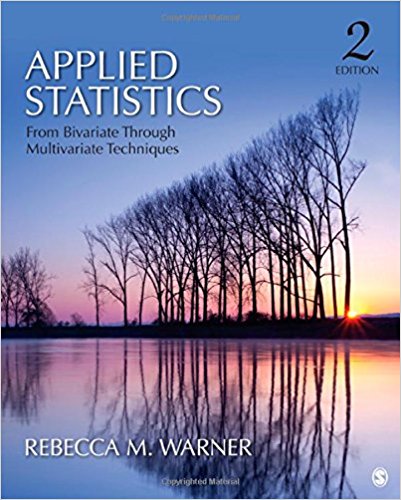
  • دانلود کتاب Applied Statistics: From Bivariate Through Multivariate 2nd

    دانلود کتاب Applied Statistics: From Bivariate Through Multivariate 2nd

    دانلود کتاب Applied Statistics: From Bivariate 2nd

    برای خرید و دانلود کتاب Applied Statistics: From Bivariate Through Multivariate Techniques با گیگاپیپر مکاتبه کنید. نسخه Epub و پی دی اف PDF تیدبل شده ان در گیگاپیپر موجود است و به محض واریز ارسال می شود. چند صفحه نمونه از کتاب “آمار کاربردی: از دو بعد از طریق چند متغیره” در انتهای پست اورده شده است.

    دانلود کتاب Applied Statistics: From Bivariate Through Multivariate Techniques دانلود ایبوک با فرمت EPUB Author Rebecca M. Warner 141299134X, 9781412991346 گیگاپیپر گیگاپیپر
    دانلود کتاب Applied Statistics: From Bivariate Through Multivariate Techniques دانلود ایبوک با فرمت EPUB Rebecca M. Warner 141299134X, 9781412991346

    Applied Statistics : From Bivariate Through Multivariate Techniques

    Author: Rebecca (Becky) M (Margaret) Warner
    Publisher: Thousand Oaks : SAGE Publications, 2012
    Edition/Format: eBook : Document : English

    Summary:
    Rebecca M. Warner’s Applied Statistics: From Bivariate Through Multivariate Techniques, Second Edition provides a clear introduction to widely used topics in bivariate and multivariate statistics, including multiple regression, discriminant analysis, MANOVA, factor analysis, and binary logistic regression. The approach is applied and does not require formal mathematics; equations are accompanied by verbal explanations. Students are asked to think about the meaning of equations. Each chapter presents a complete empirical research example to illustrate the application of a specific method.


    درباره نویسنده کتاب Rebecca (Becky) M (Margaret) Warner

    About the author (2012)

    Rebecca M. Warner received a B.A. from Carnegie-Mellon University in Social Relations in 1973 and a Ph.D. in Social Psychology from Harvard in 1978. She has taught statistics for more than 25 years: from Introductory and Intermediate Statistics to advanced topics seminars in Multivariate Statistics, Structural Equation Modeling, and Time Series Analysis. She is currently a Full Professor in the Department of Psychology at the University of New Hampshire. She is a Fellow in the Association for Psychological Science and a member of the American Psychological Association, the International Association for Relationships Research, the Society of Experimental Social Psychology, and the Society for Personality and Social Psychology. She has consulted on statistics and data management for the World Health Organization in Geneva and served as a visiting faculty member at Shandong Medical University in China.

    اطلاعات کتاب شناختی Applied Statistics: From Bivariate Through Multivariate Techniques

    Bibliographic information
    QR code for Applied Statistics: From Bivariate Through Multivariate Techniques
    Title Applied Statistics: From Bivariate Through Multivariate Techniques: From Bivariate Through Multivariate Techniques
    Author Rebecca M. Warner
    Edition illustrated
    Publisher SAGE, 2012
    ISBN 141299134X, 9781412991346
    Length 1172 pages
    Subjects Mathematics
    › Probability & Statistics
    › Multivariate Analysis

    Mathematics / Probability & Statistics / Multivariate Analysis
    Psychology / Statistics
    Social Science / Research
    Social Science / Statistics

    دانلود رایگان Applied Statistics: From Bivariate

    بخشی از کتاب بصورت رایگان آورده شده است.

    [pdf-embedder url=”http://www.GigaPaper.ir/wp-content/uploads/2018/01/9781412991346-Applied-Statistics-Watermark.pdf” title=”9781412991346 Applied Statistics Watermark”]


    Applied Statistics: From Bivariate Through Multivariate Techniques

    by Rebecca M. Warner

    Publisher: SAGE Publications, Inc

    Print ISBN: 9781412991346, 141299134X

    eText ISBN: 9781483305974, 148330597X

    Edition: 2nd

    Pages: 1208

    Copyright year: 2013

    فهرست مطالب کتاب Applied Statistics: From Bivariate through Multivariate Techniques 9780761927723

    Applied Statistics: From Bivariate through Multivariate Techniques
    Warner, Rebecca M.
    ISBN-13: 9780761927723

    Table of Contents

    Preface
    Acknowledgments
    Chapter 1. Review of Basic Concepts
    1.1 Introduction
    1.2 A Simple Example of a Research Problem
    1.3 Discrepancies Between Real and Ideal Research Situations
    1.4 Samples and Populations
    1.5 Descriptive Versus Inferential Uses of Statistics
    1.6 Levels of Measurement and Types of Variables
    1.7 The Normal Distribution
    1.8 Research Design
    1.9 Parametric Versus Nonparametric Statistics
    1.10 Additional Implicit Assumptions
    1.11 Selection of an Appropriate Bivariate Analysis
    1.12 Summary
    Comprehension Questions
    Chapter 2. Introduction to SPSS: Basic Statistics, Sampling Error, and Confidence Intervals
    2.1 Introduction
    2.2 Research Example: Description of a Sample of HR Scores
    2.3 Sample Mean (M)
    2.4 Sum of Squared Deviations and Sample Variance (s2)
    2.5 Degrees of Freedom (df) for a Sample Variance
    2.6 Why Is There Variance?
    2.7 Sample Standard Deviation (s)
    2.8 Assessment of Location of a Single X Score Relative to a Distribution of Scores
    2.9 A Shift in Level of Analysis: The Distribution of Values of M Across Many Samples From the Same Population
    2.10 An Index of Amount of Sampling Error: The Standard Error of the Mean (oM)
    2.11 Effect of Sample Size (N) on the Magnitude of the Standard Error (oM )
    2.12 Sample Estimate of the Standard Error of the Mean (SEM)
    2.13 The Family of t Distributions
    2.14 Confidence Intervals
    2.15 Summary

    Appendix on SPSS

    Comprehension Questions
    Chapter 3. Statistical Significance Testing
    3.1 The Logic of Null Hypothesis Significance Testing (NHST)
    3.2 Type I Versus Type II Error
    3.3 Formal NHST Procedures: The z Test for a Null Hypothesis About One Population Mean
    3.4 Common Research Practices Inconsistent With Assumptions and Rules for NHST
    3.5 Strategies to Limit Risk of Type I Error
    3.6 Interpretation of Results
    3.7 When Is a t Test Used Instead of a z Test?
    3.8 Effect Size
    3.9 Statistical Power Analysis
    3.10 Numerical Results for a One-Sample t Test Obtained From SPSS
    3.11 Guidelines for Reporting Results
    3.12 Summary
    Comprehension Questions
    Chapter 4. Preliminary Data Screening
    4.1 Introduction: Problems in Real Data
    4.2 Quality Control During Data Collection
    .3ExampleofanSPSSDataWorkshee
    4.4 Identification of Errors and Inconsistencies
    4.5 Missing Values
    4.6 Empirical Example of Data Screening for Individual Variables
    .7IdentificationandHandlingofOutliers
    4.8 Screening Data for Bivariate Analyses
    4.9 Nonlinear Relations
    4.10 Data Transformations
    4.11 Verifying That Remedies Had the Desired Effects
    .12MultivariateDatcreenin
    4.13 Reporting Preliminary Data Screenin
    4.14 Summary and Checklist for Data Screening
    Comprehension Questions
    Chapter 5. Comparing Group Means Using the Independent Samples t Test
    .1ResearchSituationsWheretheIndependentSamplestTestIsUsed
    5.2 A Hypothetical Research Example
    5.3 Assumptions About the Distribution of Scores on the Quantitative Dependent Variable
    5.4 Preliminary Data Screening
    5.5 Issues in Designing a Study
    5.6 Formulas for the Independent Samples t Test
    5.7 Conceptual Basis: Factors That Affect the Size of the t Ratio
    5.8 Effect Size Indexes for t
    5.9 Statistical Power and Decisions About Sample Size for the Independent Samples t Test
    5.10 Describing the Nature of the Outcome
    5.11 SPSS Output and Model Results Section
    5.12 Summary
    Comprehension Questions

    Chapter 6. One-Way Between-Subjects Analysis of Variance

    6.1 Research Situations Where One-Way Between-Subjects Analysis of Variance (ANOVA) Is Used
    6.2 Hypothetical Research Example
    6.3 Assumptions About Scores on the Dependent Variable for One-Way Between-S ANOVA
    6.4 Issues in Planning a Study
    6.5 Data Screening
    6.6 Partition of Scores Into Components
    6.7 Computations for the One-Way Between-S ANOVA
    6.8 Effect Size Index for One-Way Between-S ANOVA
    6.9 Statistical Power Analysis for One-Way Between-S ANOVA
    6.10 Nature of Differences Among Group Means
    6.11 SPSS Output and Model Results
    6.12 Summary
    Comprehension Questions
    Chapter 7. Bivariate Pearson Correlation
    7.1 Research Situations Where Pearson r Is Used
    7.2 Hypothetical Research Example
    7.3 Assumptions for Pearson r
    7.4 Preliminary Data Screening
    7.5 Design Issues in Planning Correlation Research
    7.6 Computation of Pearson r
    7.7 Statistical Significance Tests for Pearson r
    7.8 Setting Up CIs for Correlations
    7.9 Factors That Influence the Magnitude and Sign of Pearson r
    7.10 Pearson r and r2 as Effect Size Indexes
    7.11 Statistical Power and Sample Size for Correlation Studies
    7.12 Interpretation of Outcomes for Pearson r
    7.13 SPSS Output and Model Results Write-Up
    7.14 Summary

    applied statistics from bivariate through multivariate techniques second edition pdf

    Comprehension Questions
    Chapter 8. Alternative Correlation Coefficients
    8.1 Correlations for Different Types of Variables
    8.2 Two Research Examples
    8.3 Correlations for Rank or Ordinal Scores
    8.4 Correlations for True Dichotomies
    8.5 Correlations for Artificially Dichotomized Variables
    8.6 Assumptions and Data Screening for Dichotomous Variables
    8.7 Analysis of Data: Dog Ownership and Survival After a Heart Attack
    8.8 Chi-Square Test of Association (Computational Methods for Tables of Any Size)
    8.9 Other Measures of Association for Contingency Tables
    8.10 SPSS Output and Model Results Write-Up
    8.11 Summary
    Comprehension Questions

    Chapter 9. Bivariate Regression

    9.1 Research Situations Where Bivariate Regression Is Used
    9.2 A Research Example: Prediction of Salary From Years of Job Experience
    9.3 Assumptions and Data Screening
    9.4 Issues in Planning a Bivariate Regression Study
    9.5 Formulas for Bivariate Regression
    9.6 Statistical Significance Tests for Bivariate Regression
    9.7 Setting Up Confidence Intervals Around Regression Coefficients
    9.8 Factors That Influence the Magnitude and Sign of b

    9.9 Effect Size/Partition of Variance in Bivariate Regression
    9.10 Statistical Power
    9.11 Raw Score Versus Standard Score Versions of the Regression Equation
    9.12 Removing the Influence of X From the Y Variable by Looking at Residuals From Bivariate Regression
    9.13 Empirical Example Using SPSS
    9.14 Summary
    Comprehension Questions
    Chapter 10. Adding a Third Variable: Preliminary Exploratory Analyses
    10.1 Three-Variable Research Situations
    10.2 First Research Example

    applied statistics from bivariate through multivariate techniques free download

    10.3 Exploratory Statistical Analyses for Three-Variable Research Situations
    10.4 Separate Analysis of X1, Y Relationship for Each Level of the Control Variable X2
    10.5 Partial Correlation Between X1 and Y Controlling for X2
    10.6 Understanding Partial Correlation as the Use of Bivariate Regression to Remove Variance Predictable by X2 From Both X1 and Y
    10.7 Computation of Partial r From Bivariate Pearson Correlations
    10.8 Intuitive Approach to Understanding Partial r
    10.9 Significance Tests, Confidence Intervals, and Statistical Power for Partial Correlations
    10.10 Interpretation of Various Outcomes for rY1.2 and rY1
    10.11 Two-Variable Causal Models
    10.12 Three-Variable Models: Some Possible Patterns of Association Among X1, Y, and X2
    10.13 Mediation Versus Moderation
    10.14 Model Results
    10.15 Summary
    Comprehension Questions

    Chapter 11. Multiple Regression With Two Predictor Variables

    11.1 Research Situations Involving Regression With Two Predictor Variables
    11.2 Hypothetical Research Example
    11.3 Graphic Representation of Regression Plane
    11.4 Semipartial (or “Part”) Correlation
    11.5 Graphic Representation of Partition of Variance in Regression With Two Predictors
    11.6 Assumptions for Regression With Two Predictors
    11.7 Formulas for Regression Coefficients, Significance Tests, and Confidence Intervals
    11.8 SPSS Regression Results
    11.9 Conceptual Basis: Factors That Affect the Magnitude and Sign of B and b Coefficients in Multiple Regression With Two Predictors
    11.10 Tracing Rules for Causal Model Path Diagrams
    11.11 Comparison of Equations for B, b, pr, and sr
    11.12 Nature of Predictive Relationships
    11.13 Effect Size Information in Regression With Two Predictors
    11.14 Statistical Power
    11.15 Issues in Planning a Study
    11.16 Use of Regression With Two Predictors to Test Mediated Causal Models
    11.17 Results
    11.18 Summary

    applied statistics from bivariate through multivariate techniques pdf download

    Comprehension Questions
    Chapter 12. Dummy Predictor Variables and Interaction Terms in Multiple Regression
    12.1 Research Situations Where Dummy Predictor Variables Can Be Used
    12.2 Empirical Example
    12.3 Screening for Violations of Assumptions
    12.4 Issues in Planning a Study
    12.5 Parameter Estimates and Significance Tests for Regressions With Dummy Variables
    12.6 Group Mean Comparisons Using One-Way Between-S ANOVA
    12.7 Three Methods of Coding for Dummy Variables
    12.8 Regression Models That Include Both Dummy and Quantitative Predictor Variables
    12.9 Tests for Interaction (or Moderation)
    12.10 Interaction Terms That Involve Two Quantitative Predictors
    12.11 Effect Size and Statistical Power
    12.12 Nature of the Relationship and/or Follow-Up Tests
    12.13 Results
    12.14 Summary
    Comprehension Questions

    Chapter 13. Factorial Analysis of Variance

    13.1 Research Situations and Research Questions
    13.2 Screening for Violations of Assumptions
    13.3 Issues in Planning a Study
    1PDF-XCHANGE aPRO al ANOVA
    3.4EmpiricalExample:DescriptionofHypotheticalDat
    13.5 Computations for Between-S Factorial ANOVA
    13.6 Conceptual Basis: Factors That Affect the Size of Sums of Squares andFRatiosinFactori
    13.7 Effect Size Estimates for Factorial ANOVA
    13.8 Statistical Power
    1www.tracker-software.com
    3.9NatureoftheRelationships,Follow-UpTests,andInformationtoIncludeintheResults
    13.10 Factorial ANOVA Using the SPSS GLM Procedure
    13.11 Summary
    Appendix: Nonorthogonal Factorial ANOVA (ANOVA With Unbalanced Numbers of Cases in the Cells or Groups)
    Comprehension Questions
    ChapClick esto h Mbuy redNOW!
    ter14.MultipleRegrsionWitoreThanTwoPictors
    14.1 Research Questions
    14.2 Empirical Example
    14.3 Screening for Violations of Assumptions
    1http://www.tracker-software.com/buy-now
    4.4IssuesinPlanningaStudy
    14.5 Computation of Regression Coefficients With k Predictor Variables
    14.6 Methods of Entry for Predictor Variables
    14.7 Variance Partitioning in Regression for Standard or Simultaneous Regression Versus Regressions That Involve a Series of Steps
    14.8 Significance Test for an Overall Regression Model
    14.9 Significance Tests for Individual Predictors in Multiple Regression
    14.10 Effect Size
    14.11 Changes in F and R as Additional Predictors Are Added to a Model in Sequential or Statistical Regression
    14.12 Statistical Power
    14.13 Nature of the Relationship Between Each X Predictor and Y (Controlling for Other Predictors)
    14.14 Assessment of Multivariate Outliers in Regression
    14.15 SPSS Example and Results
    14.16 Summary
    Appendix 14.A: A Review of Matrix Algebra Notation and Operations and Application of Matrix Algebra to Estimation of Slope Coefficients for Regression With More Than k Predictor Variables Appendix 14.B: Tables for Wilkinson and Dallal (1981) Test of Significance of Multiple R2 in Method = Forward Statistical Regression
    Comprehension Questions

    Chapter 15. Analysis of Covariance

    15.1 Research Situations and Research Questions
    15.2 Empirical Example
    15.3 Screening for Violations of Assumptions
    15.4 Variance Partitioning in ANCOVA
    15.5 Issues in Planning a Study
    15.6 Formulas for ANCOVA
    15.7 Computation of Adjusted Effects and Adjusted Y* Means
    15.8 Conceptual Basis: Factors That Affect the Magnitude of SSAadj and SSresidual and the Pattern of Adjusted Group Means
    15.9 Effect Size
    15.10 Statistical Power
    15.11 Nature of the Relationship and Follow-Up Tests: Information to Include in the Results Section
    15.12 SPSS Analysis and Model Results
    15.13 Additional Discussion of ANCOVA Results
    15.14 Summary
    Appendix: Alternative Methods for the Analysis of Pretest/Posttest Data
    Comprehension Questions
    Chapter 16. Discriminant Analysis
    16.1 Research Situations and Research Questions
    16.2 Introduction of an Empirical Example
    16.3 Screening for Violations of Assumptions
    16.4 Issues in Planning a Study
    16.5 Equations for Discriminant Analysis
    16.6 Conceptual Basis: Factors That Affect the Magnitude of Wilks’s Lambda
    16.7 Effect Size
    16.8 Statistical Power and Sample Size Recommendations
    16.9 Follow-Up Tests to Assess What Pattern of Scores Best Differentiates Groups
    16.10 Results
    16.11 One-Way ANOVA on Scores on Discriminant Functions
    16.12 Summary

    applied statistics from bivariate through multivariate techniques 2nd edition

    Appendix: Eigenvalue/Eigenvector Problem
    Comprehension Questions
    Chapter 17. Multivariate Analysis of Variance
    17.1 Research Situations and Research Questions
    17.2 Introduction of the Initial Research Example: A One-Way MANOVA
    17.3 Why Include Multiple Outcome Measures?
    17.4 Equivalence of MANOVA and DA
    17.5 The General Linear Model
    17.6 Assumptions and Data Screening
    17.7 Issues in Planning a Study
    17.8 Conceptual Basis of MANOVA and Some Formulas for MANOVA
    17.9 Multivariate Test Statistics
    17.10 Factors That Influence the Magnitude of Wilks’s Lambda
    17.11 Effect Size for MANOVA
    17.12 Statistical Power and Sample Size Decisions
    17.13 SPSS Output for a One-Way MANOVA: Career Group Data From Chapter 16
    17.14 A 2 x 3 Factorial MANOVA of the Career Group Data
    17.15 A Significant Interaction in a 3 x 6 MANOVA
    17.16 Comparison of Univariate and Multivariate Follow-Up Analyses for MANOVA
    17.17 Summary

    17.17 Summary
    Comprehension Questions

    Chapter 18. Principal Components and Factor Analysis

    18.1 Research Situations
    18.2 Path Model for Factor Analysis
    18.3 Factor Analysis as a Method of Data Reduction
    18.4 Introduction of an Empirical Example
    18.5 Screening for Violations of Assumptions
    18.6 Issues in Planning a Factor Analytic Study
    18.7 Computation of Loadings
    18.8 Steps in the Computation of Principal Components or Factor Analysis
    18.9 Analysis 1: Principal Components Analysis of Three Items Retaining All Three Components
    18.10 Analysis 2: Principal Component Analysis of Three Items Retaining Only the First Component
    18.11 Principal Components Versus Principal Axis Factoring
    18.12 Analysis 3: PAF of Nine Items, Two Factors Retained, No Rotation
    18.13 Geometric Representation of Correlations Between Variables and Correlations Between Components or Factors
    18.14 The Two Multiple Regressions
    18.15 Analysis 4: PAF With Varimax Rotation
    18.16 Questions to Address in the Interpretation of Factor Analysis
    18.17 Results Section for Analysis 4: PAF With Varimax Rotation
    18.18 Factor Scores Versus Unit-Weighted Composites
    18.19 Summary of Issues in Factor Analysis
    18.20 Optional: Brief Introduction to Concepts in Structural Equation Modeling
    Appendix: The Matrix Algebra of Factor Analysis
    Comprehension Questions

    Chapter 19. Reliability, Validity, and Multiple-Item Scales

    19.1 Assessment of Measurement Quality
    19.2 Cost and Invasiveness of Measurements
    19.3 Empirical Examples of Reliability Assessment
    19.4 Concepts From Classical Measurement Theory
    19.5 Use of Multiple-Item Measures to Improve Measurement Reliability
    19.6 Three Methods for the Computation of Summated Scales
    19.7 Assessment of Internal Homogeneity for Multiple-Item Measures
    19.8 Correlations Among Scores Obtained Using Different Methods of Summing Items
    19.9 Validity Assessment
    19.10 Typical Scale Development Study
    19.11 Summary
    Appendix: The CESD Scale
    Comprehension Questions
    Chapter 20. Analysis of Repeated Measures
    20.1 Introduction
    20.2 Empirical Example: Experiment to Assess Effect of Stress on Heart Rate
    20.3 Discussion of Sources of Within-Group Error in Between-S Versus Within-S Data
    20.4 The Conceptual Basis for the Paired Samples t Test and One-Way Repeated Measures ANOVA
    20.5 Computation of a Paired Samples t Test to Compare Mean HR Between Baseline and Pain Conditions
    20.6 SPSS Example: Analysis of Stress/HR Data Using a Paired Samples t Test
    20.7 Comparison Between Independent Samples t Test and Paired Samples t Test
    20.8 SPSS Example: Analysis of Stress/HR Data Using a Univariate One-Way Repeated Measures ANOVA
    20.9 Using the SPSS GLM Procedure for Repeated Measures ANOVA
    20.10 Screening for Violations of Assumptions in Univariate Repeated Measures
    20.11 The Greenhouse-Geisser e and Huynh Feldt e Correction Factors
    20.12 MANOVA Approach to Analysis of Repeated Measures Data
    20.13 Effect Size
    20.14 Statistical Power
    20.15 Planned Contrasts
    20.16 Results
    20.17 Design Problems in Repeated Measures Studies
    20.18 More Complex Designs
    20.19 Alternative Analyses for Pretest and Posttest Scores
    20.20 Summary
    Comprehension Questions
    Chapter 21. Binary Logistic Regression
    21.1 Research Situations
    21.2 Simple Empirical Example: Dog Ownership and Odds of Death
    21.3 Conceptual Basis for Binary Logistic Regression Analysis
    2PDF-XCHANGE sPRO
    1.4DefinitionandInterpretationofOdd
    21.5 A New Type of Dependent Variable: The Logit
    21.6 Terms Involved in Binary Logistic Regression Analysis
    21.7 Analysis of Data for First Empirical Example: Dog Ownership/Death Study
    21.8 Issues in Planning and Conducting a Study
    2www.tracker-software.com
    1.9MoreComplexModels
    21.10 Binary Logistic Regression for Second Empirical Analysis: Drug Dose and Gender as Predictors of Odds of Death
    21.11 Comparison of Discriminant Analysis to Binary Logistic Regression
    21.12 Summary
    CClick sto er buy l CNOW!
    omprehensionQuestion
    Appendix A: Proportions of AreaUndStandardNormaurve
    Appendix B: Critical Values for t Distribution
    Appendix C: Critical Values of F
    Appendix D: Critical Values of Chi-Square
    Appehttp://www.tracker-software.com/buy-now
    ndixE:CriticalValuesoftheCorrelationCoefficient
    Appendix F: Critical Values of the Studentized Range Statistic
    Appendix G: Transformation of r (Pearson Correlation) to Fisher Z
    Glossary
    References
    Index
    About the Author

    برای سفارش کتاب زیر هم می توانید با ما مکاتبه کنید.

    Title: e-Study Guide for: Applied Statistics: From Bivariate Through Multivariate Techniques by Rebecca M. Warner, ISBN 9780761927723

    Author: Cram101 Textbook Reviews
    Subjects: science and math, education and teaching, mathematics, schools and teaching, teacher resources, statistics, applied
    Format: AZW

    [pdf-embedder url=”http://www.GigaPaper.ir/wp-content/uploads/2018/01/9780761927723.pdf”]

    دانلود رایگان Applied Statistics: From Bivariate Through Multivariate Techniques

    خرید کتاب Applied Statistics: From Bivariate Through Multivariate Techniques دانلود ایبوک EPUB Author Rebecca M. Warner 141299134X, 9781412991346 گیگاپیپر
    خرید ایبوک Applied Statistics: From Bivariate Through Multivariate Techniques

    جهت اطمینان از کیفیت کتاب، چند صفحه از ایبوک Applied Statistics: From Bivariate Through Multivariate Techniques بصورت رایگان آورده شده است.

    دانلود کتاب Applied Statistics: From Bivariate Through Multivariate Techniques دانلود ایبوک با فرمت EPUB Author Rebecca M. Warner 141299134X, 9781412991346 گیگاپیپر
    دانلود کتاب Applied Statistics: From Bivariate Through Multivariate Techniques دانلود ایبوک با فرمت EPUB Author Rebecca M. Warner 141299134X, 9781412991346
    دانلود کتاب Applied Statistics: From Bivariate Through Multivariate Techniques دانلود ایبوک با فرمت EPUB Author Rebecca M. Warner 141299134X, 9781412991346 گیگاپیپر
    دانلود کتاب Applied Statistics: From Bivariate Through Multivariate Techniques دانلود ایبوک با فرمت EPUB 9781412991346
  • دانلود ایبوک Applied Multivariate Research Design and Interpretation – Third Edition

    برای دانلود نسخه سوم کتاب Applied Multivariate Research Design and Interpretation که با فرمت epub است. و فرمت pdf تبدیل شده ان هم خدمتتتان ارسال خواهد شد، این کتاب در ارشیو موجود است.

    Title: Applied Multivariate Research: Design and Interpretation
    Authors: Lawrence S. Meyers; Glenn C. Gamst; Anthony J. Guarino
    Year: 2017
    Edition: 3
    Pages: 1016
    ISBN: 9781506329789
    Format & Size: Epub & 79.8 MB

    برای خرید کتاب Applied Multivariate Research نسخه سوم  بر روی لینک زیر کلیک کنید تا کتاب فورا ارسال شود

    دانلود کتاب Applied Multivariate Research نسخه سوم

    Book Details:

    Using a conceptual, non-mathematical approach, the updated Third Edition of Applied Multivariate Research: Design and Interpretation provides full coverage of the wide range of multivariate topics that graduate students across the social and behavioral sciences encounter. Authors Lawrence S. Meyers, Glenn Gamst, and A. J. Guarino integrate innovative multicultural topics in examples throughout the book, which include both conceptual and practical coverage of: statistical techniques of data screening; multiple regression; multilevel modeling; exploratory factor analysis; discriminant analysis; structural equation modeling; structural equation modeling invariance; survival analysis; multidimensional scaling; and cluster analysis.